Monday, May 23, 2011

Freischütz formula

Das rechte Auge eines Wiedehopfs...


...das linke eines Luchses.
Probatum est!

Thursday, May 19, 2011

another castle

Fifteen miles down the Elbe from Dresden is Meissen, with the Schloss Albrechtsburg (NOT ...berg), Germany's oldest castle (they claim).  Quite impressive.  Biked there today the long way, for a total of about 40 miles.  Toured the castle and cathedral, but didn't go to the porcelain factory.

Saw a wonderful sign within the castle area, just across from the side of the castle cathedral:  "Historical Prison, with building permits, for lease or sale."  I want to put in an offer, and when they ask what I plan to do with it, say "Keep prisoners there, of course."

I'm calling time on my last quiz.  No entries, no winners.  Constance probably thought it was too easy.  It was.  Google could solve it for you in .00017 seconds.  The answer is (a), Eisenberg.  The extra credit part was harder, and I was hoping someone could find the real answer and tell me, so I could confirm my theory:  note the year, 1934, when the name of the town was changed from Eisenberg to Moritzburg (to match the name of the major landmark there, I said).  Seems obvious to me that the Nazis decided to do this because Eisenberg sounded too Jewish to them.  But I didn't find any evidence to confirm the idea.  I still think it's right.

Wednesday, May 4, 2011

Moritzburg, Kollwitz, (quiz???)

Schloss Moritzburg


Roughly 12 miles from Dresden is a little town out in the farmland called Moritzburg, named for the eponymous castle which was a hunting "lodge" for the 17th-18th century Dresden monarchs.  Took a little trip out there recently.  Absolutely idyllic, gorgeous castle in the middle of a lake, accessible over causeways.

Rüdenhof, where Käthe Kollwitz died, with Moritzburg Lake in the background.  She had a good view.
Across the street from the lake is a house named the Rüdenhof which is now a memorial and museum to the artist Käthe Kollwitz, who spent her last year there as a war refugee from Berlin, and died in her room there on 22 April 1945.  What I learned: I knew that she had a Dresden connection, as "Käthe Kollwitz Street" runs along the left bank of the Elbe for several miles, just a couple blocks away from my apartment.  But I didn't know the details--that she came to Moritzburg as a refugee after her apartment in Berlin was destroyed in bombings in 1943, and died there at age 77.

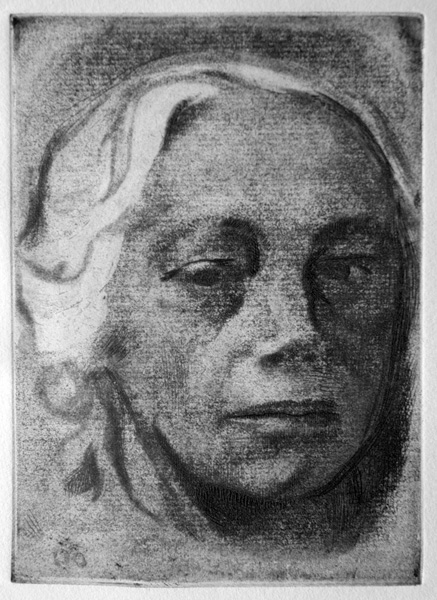
self portrait
She had lived a fairly good life as a well-respected artist, married to a doctor.  This in spite of official disapproval of her work by the Nazis.  But most of her best known work came earlier.  I don't know lots about her, but it seems my older image of her as a poor, starving woman comes more from her work, and less from her own life.  She did lose a son to WWI, however, and wartime loss and privation is certainly consistent with what I knew of her influences and aesthetic.

In 1934, the town containing the Moritzburg Castle was re-named "Moritzburg" to match the town's dominating landmark.  Here's the quiz:  What was its former name, the name it had carried for centuries?

     (a) Eisenberg
     (b) Freiburg
     (c) Herzberg
     (d) Pitzburg
For extra credit, WHY was it renamed?

Answer someday.

Monday, May 2, 2011

more funny German stuff (in my opinion)

This is a little poster on a lamp post down the street from me, left over from the February, 2011 demonstrations I wrote about at the time.  And the more I look at this, the funnier it gets.

It wants people to listen to Schönberg instead of Wagner, I take it because Wagner was beloved by Nazis and Schönberg wasn't, and was Jewish.  It shows an image of an Egon Schiele portrait of Schönberg and a well-known standard one of Wagner (whose painter I don't know).  The blue circle at the left edge calls people out to counter-demonstrations against the neo-nazis.  It even uses typography to help make its point.

My god.  People should listen to Schönberg over Wagner?  Sure, they're both great composers, but 99% + of the demonstrators would certainly prefer Wagner's music if they heard both back to back.  If they've even heard of them.  Totally silly.

Then I noticed the little line at the bottom of the sign saying who put it out.  Using lots of abbreviations, it seems to come from the anti-fascist committee of the student council of the Dresden Conservatory of Music.  Great.  Good left-wing students, as is expected in German universities.  And just as thoughtful as you'd expect, too.

Thursday, April 14, 2011

Prague, and other news

Statue of Franz Kafka in front of the Spanish Synagogue in Prague.
Visited Prague for a few days.  It's only a couple hours from Dresden by train, and there was a group from the Bay Area come to do the Mozart Requiem there.  Since I knew a few people involved, it was a good excuse to get there and see some things.  I had been there twice before in previous trips with the Symphony, each time for under 24 hours.  About time to spend some real time there.

Artist at Music Institute Library in Prague painting an allegory of music on the ceiling.
It's gorgeous.  Pretty like Dresden, but much larger.  Not an ugly building in sight.  Of course, it suffered little damage in the war, so didn't need to be re-built.  Couldn't help whistling Smetana while crossing the bridges over the Moldau, or returning to my hotel near the Vysehrad.  Of professional interest, there is a new book by a Czech musicologist named Kapsa about Baroque music and musicians at the court of Count Morzin.  Morzin was a friend of Vivaldi to whom the composer dedicated one of his many bassoon concerti (and all four of his Seasons).  One of the composers discussed in the book is Reichenauer, who wrote a number of concerti for oboe and/or bassoon.  I'll be doing one of his double concerti in Phoenix this June.  Unfortunately for me, the book is in Czech, with only a brief summary chapter in English.  But it contains catalogs of several of the composers' works, which is very useful.  Bought several copies--for me and some Dresden friends.  Went on a wild goose chase looking for Mr. Kapsa himself, only to determine that he was on vacation.  Finally reached him by email, and we'll get together should I ever go back to Prague.

What's the name of this restaurant?
You can practice your days of the week in Czech.
Praguers do funny things, too.  I noticed this restaurant, and wondered why they didn't include the name of the restaurant on the sign.  I finally found the name on a small paper in the front door (you can barely see it in the above picture).  And I figured out why they didn't put it up in lights:


 In other news, I'm starting to get serious about practicing the bassoon.  Like every day.  And I've learned that the first "wave" of Dresden Baroque music to be published in the project I'm working on will consist of eight volumes.  The first is the bassoon concerto collection, and there are seven others I'm not sure of.  One of them will be a pair of early Baroque "opera-ballets," which contain stylistic elements from Italy, France, and Germany.  I know this because I translated the foreword of the volume into English.  There may also be some sacred cantatas, and I don't know what else.  There is some delay in the technical side of getting this material onto the web and accessible to the public.  Not my department.  The second "wave" of scores to be published will contain a volume of oboe concerti which I am working on, and perhaps a volume of double concerti, since there are many of those in the library.  This wave is even more up in the air. 

Saturday, April 9, 2011

answers to "next quiz"

Me in my apartment.
Answers to the previous quiz:  A-2, B-4, C-1.  Or 1-C, 2-A, 4-B, if you will.  There was no prison pictured.

No, the synagogue and the library are not by the same architect, though they look extremely similar.  The synagogue is on the site of the old Semper synagogue, destroyed on 9 November 1938.  No windows to break on its god-awful replacement.

Prize once again goes to Constance, who claims to have used her computer to help solve it.  But this is all on computer, so is that cheating?  Dad also figured out one of them.  Besides the glory, Constance, what would be an appropriate prize?

Haven't thought up another quiz for this time.

Recently spent some time with a German book called "Jewish Wit," or something like that.  First published in 1960 with the express purpose of trying to bring Germans and Jews closer together.  650 pages of humor from (or about) all ages, including the Nazi time:

A Jew goes to the courthouse and asks the clerk if he can get his name changed legally.  "Only in extenuating circumstances," says the clerk.  "What is your name?"

"Adolf Stinkfuss," says the Jew.

"Oh, I see.  And what do you want to change it to?"

"Moritz Stinkfuss."

Tuesday, March 22, 2011

next quiz

A
B
   
C
Match the photo with the correct Dresden building.  One name needs to be discarded.

(1) Library
(2) Police HQ
(3) Prison
(4) Synagogue

Answer soon.

Last quiz answer:  the store, Doppellotte, takes its name from Das doppelte Lottchen by Erich Kästner.  The two names mean essentially the same thing:  "Double Lotte" (Lotte is a name short for Charlotte).  It was written in the late 1940s by Dresden favorite-son author Kästner, a writer of mostly light fiction.  (On the more serious side, I can highly recommend his Fabian.)  Intended for the cinema, Double Lottie has been filmed several times in German and in English, the most recent of which is The Parent Trap by Disney, featuring the young and talented Lindsay Lohan playing the roles of both twins who were separated at birth.

Congratulations to Constance, who figured out part of the answer, and submitted the only response.  She noticed the "Doppel" in the store name, figured it meant "Double," and thus referred to twins.  And she knows The Parent Trap, though I'm not sure why.