What's new with Thabo?
Thabo apparently has been in limbo for some time in Pittsburgh, or perhaps at the Pittsburgh Zoo's huge facility a couple hours away. There was also some apparent political difficulty with announcing the acquisition at the time of his arrival. Anyway, here's some news from the Post-Gazette from the end of March, 2012:
http://www.post-gazette.com/stories/local/region/pittsburgh-zoo-hopes-elephant-will-soon-sire-calves-by-the-ton-312341/
In Defense of Animals doesn't like the whole Thabo business:
http://www.helpelephants.com/pdf/PITTSBURGH_calf_import_8_22_11.pdf
But I guess that's their job.
Friday, May 25, 2012

Friday, August 5, 2011
Dresden to Pittsburgh
 |
| Thabo |
 |
| Such a cutie! |
 |
| little Thabo-Umasai (his full name) |
Monday, August 1, 2011
Neighborhood connections: Hellerau-Plauen
 |
| Hellerau |
 |
| Plauen |
Hellerau and Plauen are neighborhoods in two opposite corners of Dresden which I visited in my last week here. I am writing this in the airport awaiting my flight back to the US. I chose to go there because the brochures about them put out by the local transit authority made them sound interesting. They were.
The brochures describe walking routes around the neighborhoods, pointing out interesting sights. The point is that by taking public transportation around Dresden, one can see really interesting stuff. I, of course, rode my bike, and found connections between the two places that were most interesting (to me), and probably not often noticed.
 |
| Hellerau row houses... |
 |
| ...and gardens. |
 |
| Weisseritz gorge at Felsenkellerei brewery. |
I visited them in alphabetical order. Plauen is a planned garden community, designed at the beginning of the beginning of the twentieth century after the model of English garden towns. It was intended to offer workers and others a place to live away from the noise and pollution of the city, and is in a peaceful, wooded area. The many distinctive row houses are tiny, but all are connected with small garden plots. Apple trees abound. Near the edge of the community, the planners placed a public well and a linden tree, something that the brochure says is typical of small towns.
The designers also included provisions for artistic life. There is a large hall which was to serve as a performance space for dance and music, and Émile Jaques-Dalcroze was brought from Switzerland to lead a music and dance school. The hall now houses the European Center for the Arts, a festival of modern dance, music, and art. It was initially a hotbed of the avant-garde, but World War I soon stopped all further cultural life and development before it could really establish itself. In the Communist times, the hall and surrounding buildings housed Soviet soldiers and their gym.
The next day, I travelled to the Dresden area of Plauen. It was an industrial area with large millworks and a brewery, situated on the Weisseritz, a tributary to the Elbe. The Weisseritz goes through a spectacular gorge there, and the Felsenkellerei aged their beers in cool cellars dug into the rock. The brochure walk goes through woods and along the river and up the ridge and back into the town. In the town area of Plauen, the businessman Bienert, who ran the industry here, had a fountain built in honor of the German poet Wolfgang Müller (above). Probably because Bienert made his fortune primarily in milling, and the poet's name means "miller," and he wrote romantic poetry about millers.
Wolfgang Müller lived in the early nineteenth-century and is known now primarily because he wrote two cycles of poetry that Franz Schubert immortalized with his musical settings, Die schöne Müllerin and Die Winterreise. The fountain in Plauen shows the young miller hiking, with a quote from the first poem of Die schöne Müllerin at his feet: "Wandering is the miller's delight." And under that, you can see a millwheel.
The connection to Hellerau is seen in the first photo above: Die Winterreise's fifth song is called "The Linden Tree," and starts "At the fountain near the gate stands a linden tree." So Schubert and Müller unwittingly tie together these two Dresden neighborhoods, which didn't or barely existed when they wrote the songs. Nice performances on youtube for "The Linden Tree" with Schreier and Eschenbach:
http://www.youtube.com/watch?v=05E3cVI88hA
and "Wandering" with Pears and Britten:
http://www.youtube.com/watch?v=eqgvp751if4
It has rained four days straight in Dresden, including the day of my departure. It was very sad to leave, but the bad weather made it easier. Maybe it was crying. But I'm going home.
Saturday, July 30, 2011
Wrapping up.
 |
| Public art--Kollwitz portrait after her self-portraits. |

In another lifetime, I would go around the town seeking out and photographing all such stations. They're all over, and quite wonderful.

 |
| a "prince" of a bike. |
As for this blog, I do plan to add a little more to it after I get home Monday night. (Perhaps long after.) I would like to say a little more about the musical projects I have been working on in Dresden, which are ongoing. There is plenty more for me to do that I can handle online from Pittsburgh.
Der Freischütz by Weber
 | |
| Saxon Switzerland |
 |
| Backdrop to the Felsenbühne. |
 |
| View toward upstage, where the bullets were cast (under the frame). |
The State Theaters of Saxony, which have productions across the state, run the Felsenbühne. Their orchestra plays, and the singers and production workers are employed by the State Theaters as well. Quite competently done, excellent wind playing in the orchestra, and the soloists were very good (but not great). It's certainly a tough venue to play. It threatened rain the whole time, and I learned that if it starts to rain, they stop the production for a few minutes (I guess to put on raincoats, etc.), and then continue. It didn't start.
 |
| The tuba is smokin'! |
Back to the Felsenbühne. The show was a total thrill, seeing it performed right there where it happened.
Tuesday, July 26, 2011
VW ad
This post sponsored by Volkswagen:
Subtitles available.
(I don't mind plugging them, since they have a major new factory here in Dresden, and they support the arts here bigtime.)
Subtitles available.
(I don't mind plugging them, since they have a major new factory here in Dresden, and they support the arts here bigtime.)
Monday, July 25, 2011
Spreewald

 |
| Ladies on a flatboat in the town of Lübben munching on pickles. |
My German friends, the Weidners, invited me for a weekend up there in the Spreewald in mid-July. One day, we rented kayaks and paddled the river and canals (never sure which was which), and the other day, we did a bike ride, mostly on dykes between waterways and farmland. Stayed the one night at what was essentially a B&B run by a middle-aged woman on her grandparents' old farm. (She gave me a jar of you-know-what as a parting gift.)
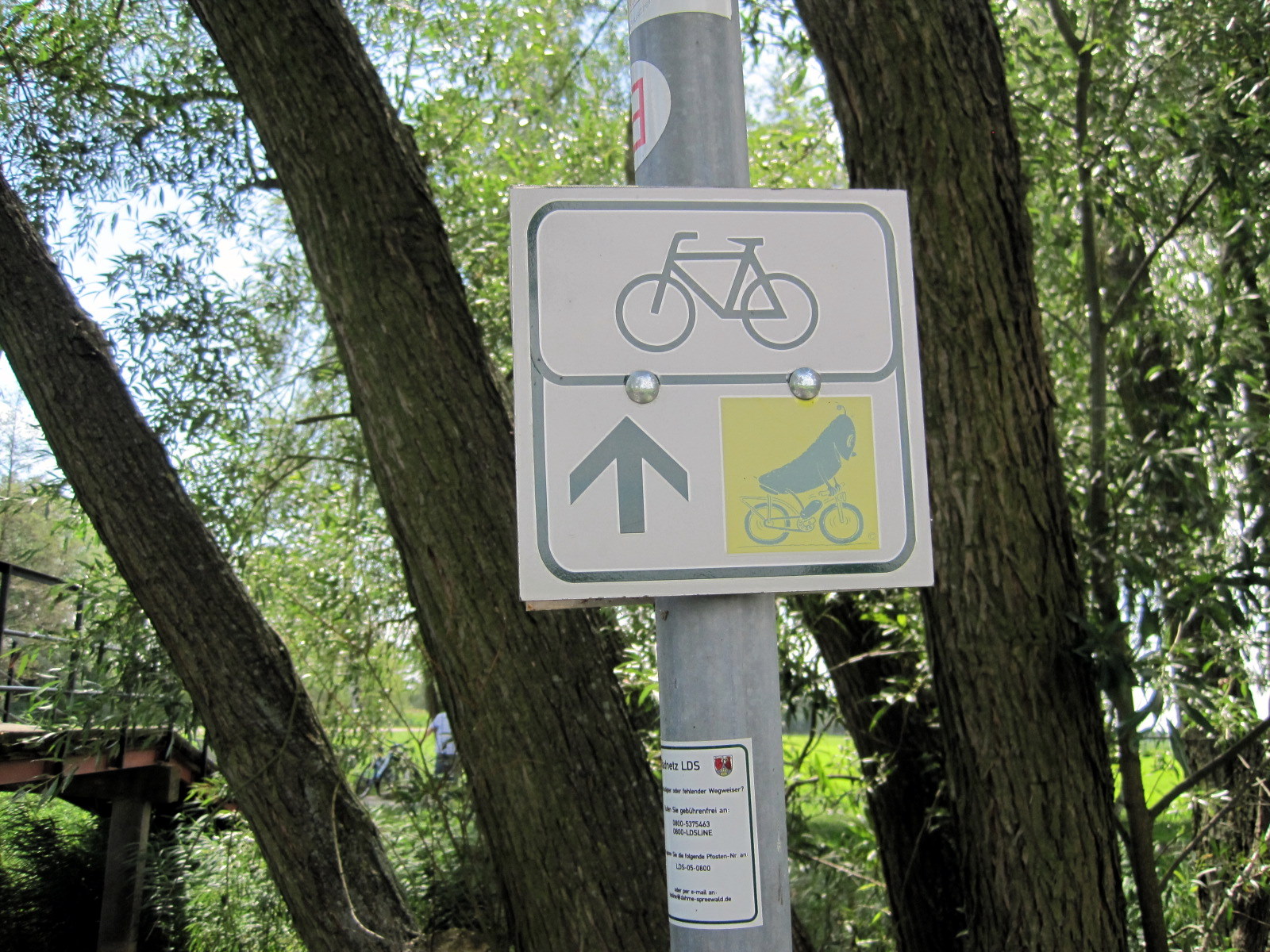 |
| One of many bike trails in the region. The Pickled Pedaler? |

To cap it all off, the highlight of the trip, the final sight before heading home was, yes, the.....
 |
| Pickle Museum! |
Subscribe to:
Posts (Atom)