Tuesday, March 22, 2011

next quiz

A
B
   
C
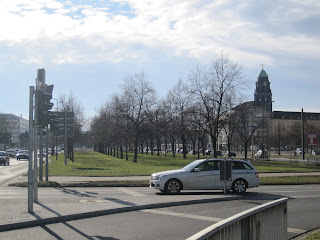
Match the photo with the correct Dresden building.  One name needs to be discarded.

(1) Library
(2) Police HQ
(3) Prison
(4) Synagogue

Answer soon.

Last quiz answer:  the store, Doppellotte, takes its name from Das doppelte Lottchen by Erich Kästner.  The two names mean essentially the same thing:  "Double Lotte" (Lotte is a name short for Charlotte).  It was written in the late 1940s by Dresden favorite-son author Kästner, a writer of mostly light fiction.  (On the more serious side, I can highly recommend his Fabian.)  Intended for the cinema, Double Lottie has been filmed several times in German and in English, the most recent of which is The Parent Trap by Disney, featuring the young and talented Lindsay Lohan playing the roles of both twins who were separated at birth.

Congratulations to Constance, who figured out part of the answer, and submitted the only response.  She noticed the "Doppel" in the store name, figured it meant "Double," and thus referred to twins.  And she knows The Parent Trap, though I'm not sure why.

Friday, February 25, 2011

funny things Germans do

Remember Fidelio F. Finke Street?  (See 20 December 2010.)  Well...through my connections, I was led into the music department offices of the big library -- closest I've come to the actual manuscripts I'm working on.  And there hanging in the hallway was a set of pastels of scenic designs for Finke's 1960 opera, Der Zauberfisch, or The Magic Fish.  Whipped out my camera and took a couple shots.  (This is the good one.)  Finke was a favorite composer of the communist East German regime.  Born elsewhere, he lived, worked, and died in Dresden.

Look who's selling cars these days!  I've also seen him pitching a cola brand.  I guess the famous photo of him is out of copyright.  In case you can't see it well, it's Che Guevara, the revolutionary.  And Dacia must be a make of car we don't have.

Right down the street from the German Hygiene Museum is the "Ace Beer Bar."  Here's a picture.  After I had taken no more than 2 or 3 shots, a lady came out of the "Ass" and chased me away, asking what I was "so eagerly photographing."


Speaking of hygiene (and protection)--the one on the right is "extra wet," by the way:


They love Asian food here in Germany.  Most of it, regardless of type, is prepared by Vietnamese emigres.  Here's a great offer.  The Schwein Yaki costs 5.50 Euros, in case you can't read the price.

And finally, a quiz.  Here's a photo of a store in the Neustadt neighborhood of Dresden.  Doppellotte.  Your question is:  what does this store have to do with the stupid 1990s Disney comedy, "The Parent Trap?"  No, the store doesn't appear in the film, in any way.  Answer next time I get around to writing.

Sunday, February 13, 2011

13 February 2011

A couple of quick speeches at the Rathaus...
I woke up today to an inch or two of new snow with freezing temperatures, and went to the human chain demonstration called by the mayor for 2 pm.  Here is a view of the chain looking down Saint Petersburg St., where I had taken a photograph to illustrate yesterday's blogg post.  Note snow, and human chain.

...and people set out to take their places.
I personally saw no evidence of any right-wingers at all.  I may have been somewhat confused, because there are calls for another demonstration against neo-nazis to be held next Saturday the 19th, for no apparent reason of anniversary or whatever that I can tell.  A "solemn vigil" has been called "against right-wing extremists" from 11 to 5 that day:  http://www.dresden.de/de/02/035/mahnwachen.php?shortcut=mahnwachen  But I have read that there was to be a "funeral march" through the old part of town by the neo-nazis today.

So nothing to terribly earth-shattering about today's 66th anniversary vigil.  At least nothing likely to make American news.  Except for me -- I was there.  Here is one of the most understated monuments I have ever seen, between the paving stones in the middle of the Old Market square in the middle of town (where the Christmas market is held, among many other things):
"After the air attacks on Dresden of 13-14 Feb 1945, the bodies of 6865 human beings were cremated here."

Saturday, February 12, 2011

13 February 1945

We are at the 66th anniversary of the destruction of Dresden in the last year of World War II.  The anniversary is obviously a major event here every year. The destruction was far and away more devastating than Dresden's military importance warranted (though the importance was apparently not negligible).  The Americans and British sent bombers to destroy the city and help break the spirit of the German people. Kurt Vonnegut witnessed it from the relative safety of a slaughterhouse a mile or so from downtown, where he was a POW.  From my vantage point 66 years later, I do have some observations.
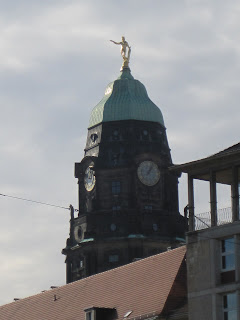
The above photo is the iconic one of the destroyed city.  Photographer Richard Peter climbed the tower on the Rathaus, which miraculously was spared destruction, and stood behind the statue on top for this shot.  The destruction of the city center was, as you can see, total.  Pictures taken a couple years later, after the rubble had been removed, show wide open fields in what was once dense city, sometimes with flocks of sheep grazing and shepherds tending.  I have spent rather little time searching the internet for this, but I'm sure there exists a map showing the extent of the destruction.  I do know that it extended into and well beyond my neighborhood of Johannstadt.  By the way, a few years ago, the Rathaus tower was renovated, and a gilded statue placed on top:

The other day, Lisa and I went on the Kurt Vonnegut tour of Dresden, primarily at the big former slaughterhouses north of downtown near the Elbe.  It's run by a small tour organization, and can be booked for a reasonable price here:  http://www.kurtvonnegut-tour.com/
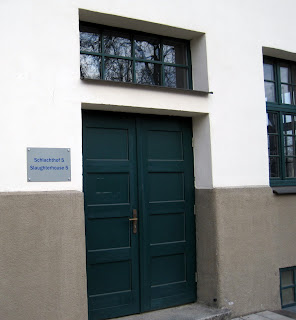
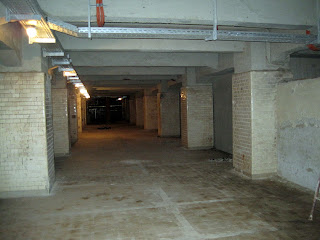
Our guide, Danilo, was remarkably informative, with lots of information on the history of the destruction, the numbers of the dead (and the controversies surrounding the number), and of course, Vonnegut's place in it.  The giant slaughterhouse complex was built around 1910, and was "decommissioned" some years ago.  It is now the fairgrounds for trade fairs in Dresden, and is still in flux -- partly still evolving into fairgrounds and a hotel, partly (and slowly) being renovated for historical interest, and partly being used for a large annual modern art exhibition called the Ostrale.  Danilo's group has gotten them to open the one cellar still in existence to show visitors on his tours.  He has convinced them to put up a plaque that says "Slaughterhouse 5," and hopes eventually to get a small Vonnegut museum placed there.  The cellars were used as cool storage for animal carcasses prior to processing, and it is where the POWs were housed.  It cannot be said with certainty that the one that is open is exactly where Vonnegut stayed, but it is close enough. 
In general, the slaughterhouse complex now looks eerily like a former concentration camp (or not so eerily, if you're from PETA).  The giant indoor stockyards seem to have guard towers, and there are scary looking smokestacks and creepy buildings you can't go into.  We'll see what it looks like in another decade or so.  The renovations here lag way behind other re-building being done in the inner city since reunification.
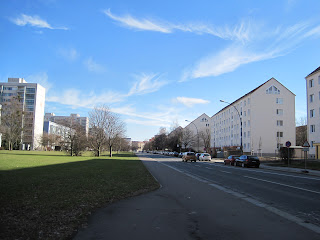
Pillnitzer Str.
St. Petersburg Str.
Which brings me to another subject:  the massive bombing 66 years ago certainly wiped out the city, but in four decades, the communist dictatorship was unable to rebuild very much.  They built housing and basic infrastructure, but didn't have the "Kapital" to rebuild much of the historic stuff.  The Semper Opera House, they did.  The Frauenkirche (Church of Our Lady) had to wait until the capitalists took over.  So this latter basic completion to the famous Dresden skyline had to wait until 2004 (though I do agree with the communists' priorities).  But what you see now is a very odd city.  The central old city has been about 3/4 rebuilt with restored or reconstructed buildings that match or imitate in modern style what used to be there, and mostly since reunification.  But beyond downtown is a very different landscape.  Often you see one 5-6 story apartment building after another, with oddly wide streets and enormous open spaces almost like giant front yards, often planted with fairly young trees.  The picture above is just outside of downtown.  I can only imagine the city was once more densely built than that.  Downtown, the old St. Petersburg St. is relatively bare.  In contrast, West German cities were more uniformly and organically rebuilt.  Overall a better plan.

I remember from listening to East German radio in the early 80s that they never missed an opportunity to note the destruction of Dresden "by Anglo-American bombers."  They never mentioned, of course, that the East Germans' great friend, the Soviet Union, did indeed push for the bombing of Dresden during the war.  Is all history revisionist?

I am writing this on Saturday the 12th.  Tomorrow, the anniversary of the bombings, will have big demonstrations downtown.  The neo-nazis are descending from all over to memorialize the huge numbers of innocent Germans killed in the war.  They were victims, too.  The neo-nazis plan a big march.  But at least as far as the publicity that I am aware of indicates, their march will be dwarfed by a human chain demonstration surrounding the inner city:  http://13februar.dresden.de/de/menschenkette.php
I plan to be a part of it.  It is being called for by a huge coalition, starting with Mayor Helma Orosz.  Unfortunately, last Monday she had surgery to remove a breast tumor, so she will be represented by the Vice Mayor.  The University is a big organizer of the event, and religious and union groups are also involved (including the Jewish community).  There is a big controversy, as well as plenty of uncertainty, as to the legalities in such protests, and what the police will be doing.  Last year, apparently, the police did not protect the neo-nazi demonstration from counter-demonstrators.  I don't know exactly what happened, but it lead to a court case where it was just ruled that the neo-nazis had the right to demonstrate peacefully, and the police should have protected them.  I am hearing that this year, the police will protect the neo-nazi demonstration, to the displeasure of most, and probably to the anger of the far left protesters.  I expect to be far from any clashes that might occur, though I predict little real problem.  Germany has laws against certain Nazi symbols and rhetoric, though political parties can be about as far right as they want.

One of the long-standing controversies is over the number of civilians killed here 66 years ago.  An official commission recently thoroughly investigated the matter and decided that the true figure lies between 25,000 and 32,000 people.  The neo-nazis of course use an inflated figure, in spite of the commission's finding.  And figures up to 300,000 have been used practically from the start.  What can one say?  Is 30,000 people burnt alive better than 300,000?  Of course.  Did the Germans have it coming?  I learned that the Geneva Conventions didn't get around to "banning" targeting of civilians like that until the 1970s.  The answer for some people is that the event was a horrible thing, not justified, but also not entirely wrong.  It was a terrible time in our history.

Sunday, January 23, 2011

some work

How about I write about some of the work that I'm doing, for a change.

I've said I am working on the oboe concerti.  I have received pdf files of four concerti (Graun, Heinichen, Reichenauer, and Ristori) that have been input from the MSS (manuscripts).  And just a few days ago, the Professor gave me (finally!) copies of the MSS from which the pdfs were produced, so I can check for errors and make suggestions where I feel there are discrepancies or "typos" in the originals.  The pdfs I have are copies from when they were input on Finale, a music program that we're actually not using.  We're using Sibelius now, and I hope to get the experts in such things to transfer the oboe concerti (not to mention the bassoon concerti) to Sibelius so I can directly edit them if need be.

So I'm sitting at the piano, playing through the pieces slowly and repeatedly, and seeing what I think.  In the case of one of the Reichenauer concerti, for example, I don't think it's as good a piece as the other one by him that is included in the collection of MSS.  So here, I plan to suggest that the better one (F major) replace the less good one (B-flat major) in the set of four concerti to be published.  I am inputting the F major into Sibelius, and have done two of the three movements so far.  I'm getting better and faster at using the program, and it's not that hard.  The fine points of things like formatting and producing individual instrumental parts are harder to learn.  The program is phenomenally complete -- you can do anything with it.  Want to write a duet for whistler and quintfagott?  It will set up the score and make sure you keep within the limitations of both "instruments," then play the piece back with appropriate synthesized sound.

The Professor is showing up at school more and more often as his broken ankle is improving.  That has slowed him down a lot and delayed much of my collaboration with him.  I'm trying to do helpful work without much direction and guidance.  He promises to sit down with me soon as things get back to normal, so we can discuss details.  One thing I need to be doing, with a March 1 deadline, is to write an article for the Journal of the International Double Reed Society on the subject of Dresden double reed concerti of the late baroque, and the new publications we're working on.  Did I mention that the "publication" is intended to be online only?  As I understand, the music will be available to everyone at no cost on line.  I guess one would need to print it as needed for practice and performance.

Another question I have brought up once, and need to follow up on, is the idea of producing piano reductions of the orchestra parts.  All soloists need to be able to run through the music with piano, and expect a piano reduction to be available.  When one buys the music to a concerto, it always comes with a solo part and a piano part.  As far as I know, this has not yet been a part of the project, and I will argue for it.  Once more, Sibelius to the rescue.  It is apparently possible to produce a reduction of orchestra music using the program, though I haven't yet learned how.  And fortunately, the orchestral scores are for the most part quite simple -- two violin parts, viola, and continuo.  Only one concerto that I have seen has any orchestral winds at all.

Schloss Albrechtsberg
The biggest news in the non-musical side of my life here is my acquisition of a bicycle.  For 100 EUR, I got me a used mountain bike, and I'm loving it.  I ride everywhere, in all kinds of weather (though it has not been overly snowy since I got the bike).  Haven't ridden public transit since.  Rode up to the Albrechtsberg Castle to see a chamber concert the other night -- octets by Schubert and others played by members of the Dresden Philharmonic.  Here's the hall where they played, and a close-up of the unusual bass the guy used.  If you look carefully at the stage, you can see tall music stands and no chairs.  All but the cellist played standing up.  (Get an American group to do that!)

Till next time.

Friday, January 7, 2011

what do you expect when you arrive in mid-December?

My building at night.  Top left two pairs of windows are mine -- bedroom on left, living room on right.


.....Things take time, especially if you've got major holidays right after you arrive.  German comic strip:  angel congratulates God on the birth of his new son, and God says, "Couldn't she have waited to give birth until after the holidays?"

I'm in the apartment and it's pretty nice, with some problems here and there.  One was just resolved yesterday:  I finally got them to sell me some tokens for the washer, and now I can do laundry (including comforters and mattress pads that were in the furnished apartment).   More pictures to come, but here's the side of the building with mural.  I put an red arrow on right where you'd have to drill through to hit my bed.

Internet connections, too, take their time.  Before they can install my wired connection (why it takes 2 weeks to flip a switch, I don't know), they gave me a wireless USB stick to connect with.  That's what I'm using now.  It's pretty slow, and it also doesn't seem to like my email.  (Receives, but I can't send.)  I do have an alternate that I can use for the time being.  I hope with the more permanent connection, email will be up to speed.

Sibelius.  That's the name of the musical score writing and editing program that is being used here for the project.  It's probably the predominant such program anywhere.  It's in its sixth edition, so guess what music plays when you open it?  Got it installed through the university here around December 21, and when my computer had a minor crash a couple days later, Sibelius decided it wanted the code number re-entered.  Unfortunately, that was available only in the music building, which was closed -- for the holidays.  Finally got it again on January 5, and am just now working on figuring out how to use it.  It's unbelievably thorough and complex (can even score accurately for Quintfagott), and is said to be quite easy to use.  Once you master it.  I'm getting there, if belatedly.

It's still pretty icy here, though we might be getting a short spell of above-freezing weather.  Here's what can happen to a bicycle:
(Icicle bicycle?)

Had a nice chat with a friendly grad student who helped me with Sibelius, and who knows the scene here pretty well.  Good to get another angle on things.  Also spent a little time with an assistant professor who is teaching a Wagner course -- Parsifal, now.  I sat in on their class, and guess what?  Most of the students hadn't done the reading!

Now maybe I'll actually sit down with the oboe concerti and dig in.

Wednesday, December 29, 2010

biding my time, patiently

My long wait will be over tomorrow, Thursday the 30th, when I finally get to move into my apartment.  All didn't exactly well with moving in.  They claimed they couldn't get the cleaning done any sooner (including carpet shampooing and wall painting).  Meanwhile, I've been in a small but pretty pension near my host family, as Grandpa came to spend the holidays, and wanted his bedroom back.

Some Dresden scenes:

It's still cold and snowy, still beautiful, and still hard to get around and see stuff.  Temps are cold -- down to the low single digits (F.) tonight.  And while most bigger streets are cleared, most public walkways are ignored and are thus snowy and icy.  So I'm not doing the long walks through town I would want to do to get to know the lay of the land.  At least I can get around by public transit and some walking, and am not stuck in an airport somewhere in western Europe (or eastern N. America).

In the middle of downtown Dresden every year since 1434 is a Christmas market called the Striezelmarkt, Striezel being local dialect for Stollen.  But by December 27, they dismantle the booths and it's over.


Here are the Ampelmännchen in action:

They are the pedestrian crossing lights left over from the old East Germany.  After reunification, there was apparently an outcry when the newly unified government tried to change them all to the western-style lights.  So the old ones are back, and everyone loves them.  They've even invented an Ampelmädchen to keep the old guy company.

If that wasn't enough German cuteness, try Sheepworld, and its signature motto that translates to "Without you, everything is dumb."
http://sheepworld.de/produktwelt/ohne-dich-ist-alles-doof/ 
All the rage here, with kids and adults.